
Bandyopadhyay told PTI that he received a call from Parliamentary Affairs Minister Kiren Rijiju and the external affairs ministry, and was asked to go to the US but he informed them that he would not be able to go due to health reasons.
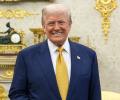
Trump, who has repeatedly said that he stopped the conflict between India and Pakistan through trade, last Friday said for the first time that "five jets were shot down" during the fighting.
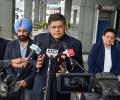
'It is high time that the 'war on terror' is removed from our diplomatic toolbox.' 'Certainly, our parliamentarians have no role in it,' asserts Ambassador M K Bhadrakumar.
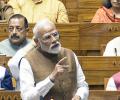
Prime Minister Narendra Modi defended India's actions against terrorism, stating no country stopped India and criticizing the Congress party for not supporting the armed forces. He highlighted the success of Operation Sindoor and warned Pakistan against further misadventures.
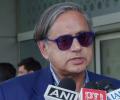
Senior Congress leader Shashi Tharoor on Tuesday said his article on Operation Sindoor's global outreach was not a sign of his 'leaping to join' Prime Minister Narendra Modi's party but a statement of national unity, interest and standing up for India.
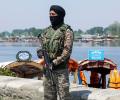
The United Nations Secretary-General, Antonio Guterres, has called for de-escalation between India and Pakistan, expressing deep concern over rising tensions following a terrorist attack in Jammu and Kashmir. Guterres reiterated his condemnation of the attack and urged both sides to avoid a confrontation, which he described as catastrophic. The Secretary-General has also offered his good offices to support de-escalation efforts. The President of the UN General Assembly, Philemon Yang, has also expressed concern over the escalating violence and called for a resolution through diplomatic means. Meanwhile, Pakistan has denied any involvement in the attack and reiterated its commitment to fighting terrorism.

The political and ideological differences between the Congress and Shashi Tharoor is no longer a matter of whispers.

Decisive action has replaced dossiers and the new India can go to any extent to uproot terrorism, Defence Minister Rajnath Singh said on Monday while stating that Operation Sindoor was on pause as the armed forces had achieved the desired objectives.

Interacting with reporters in Kolkata, the Trinamool national general secretary reiterated that his party stood with the government in matters of national interest, combating cross-border terrorism, and safeguarding sovereignty.

In a post on X, Sherman said that he 'emphasised to the Pakistani delegation the importance of combatting terrorism, and in particular, the group Jaish-e-Mohammed, who murdered my constituent Daniel Pearl in 2002'.

'Marathwada is the suicide capital of Maharashtra.' 'To stop such man-made disasters, the government should immediately come up with a rightful package, not this charitable approach to compensation.'

This came after Pakistan People's Party chairman Bilawal Bhutto Zardari on Saturday stated that Pakistan's Prime Minister Shehbaz Sharif had tasked him to lead a delegation to present Pakistan's case on the recent escalations of tensions between the two nations.
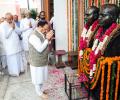
'As we read and assess what is going on around us in the India of 2025, it is instructive to do this through the lens of 75 years ago and the events that led to the formation of the BJP as we know it,' recalls Aakar Patel.
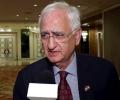
Congress leader Salman Khurshid, who is a part of India's diplomatic mission abroad, on Monday said it is 'distressing' that people back home are calculating political allegiances and asked if it is 'so difficult to be patriotic'.

"The responsibilities of member states must be assumed by member states and let's not make the UN the scapegoat of the failures or of the negative actions that are committed by member states," he said.

Pawar recalled that he was a member of a delegation sent by former prime minister P V Narasimha Rao to the UN under the leadership of BJP leader Atal Bihari Vajpayee.

'However, we must implement a tit-for-tat approach -- reciprocating their conduct with precision.' 'If they demonstrate respect, we respond accordingly. If they adopt hostile positions, we mirror that hostility with equal intensity.'

Pakistan's former foreign minister Bilawal Bhutto-Zardari on Monday said his country will go to war if India denies Islamabad its fair share of water under the Indus Waters Treaty (IWT).

United Nations leaders and agencies have welcomed the entry of a humanitarian aid convoy into Gaza via the Rafah border crossing with Egypt but noted that it is only a small beginning, still far from enough and reiterated their appeal for an immediate ceasefire.
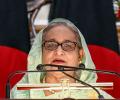
Bangladesh's International Crimes Tribunal is set to formally hear charges against deposed prime minister Sheikh Hasina on Sunday allowing state-run BTV to broadcast live the event, a first such instance in the country's history.
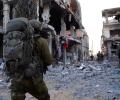
'The message that India has conveyed since the start of this conflict is clear and consistent. It is important to prevent escalation to ensure continued delivery of humanitarian aid and to work towards an early restoration of peace and stability. A peaceful resolution of the conflict through dialogue and diplomacy is the only way forward'

A two-member team of the United Nations High Commissioner for Refugees (UNHCR) met Rohingya Muslims at a slum in Jammu amid a heated debate whether the illegally settled immigrants be provided water and electricity.

Gandhi urged the prime minister to speak out "clearly, boldly and forthrightly" on behalf of the legacy that India has long represented.

According to the complaint, Awami League leaders and activists attacked the protesters and hacked Hossain to death with sharp weapons.

India's National Security Advisor Ajit Doval is expected to attend a major security meeting in Moscow next week, organized by Russia's Security Council. Doval is invited for the 13th international meeting of high representatives for security issues, taking place from May 27-29. The meeting, chaired by Sergei Shoigu, Secretary of the Security Council of the Russian Federation, will see participation from over 150 countries and international organizations. Pakistan's NSA, Lt Gen Asim Malik, is also expected to attend the meeting, leading to speculation of a possible face-to-face meeting between the two NSAs amidst heightened tensions between India and Pakistan following the Pahalgam attack and subsequent retaliatory actions.
'The quality of justice is directly linked to the quality of judges -- if that suffers, justice delivery suffers.'

A cross-party delegation led by Congress MP Dr Shashi Tharoor is visiting key American nations to rally global support for India's counter-terror stance under Operation Sindoor, spotlighting regional stability and Pakistan-backed cross-border threats.
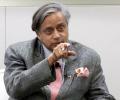
"China is an absolutely impossible factor to ignore in what has been our confrontation with Pakistan," Tharoor said.
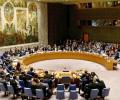
The United Nations Security Council held closed-door consultations on rising tensions between India and Pakistan, with envoys calling for restraint and dialogue. The consultations, requested by Pakistan, lasted for about an hour and a half. UN Secretary-General Antonio Guterres expressed concern over the tensions, urging both countries to avoid a military confrontation. India's former Permanent Representative to the UN, Syed Akbaruddin, said that no consequential outcome could be expected from the discussion.

Voicing his deep concern, the UN chief said that the "hospitals in the south of Gaza are already at capacity and will not be able to accept thousands of new patients from the north."
What was the aim of Operation Sindoor? Why was the operation halted so soon? asks Lieutenant General Prakash Katoch (retd).
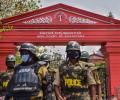
The Karnataka high court has granted an interim stay on criminal proceedings initiated against Bharatiya Janata Party leader Amit Malviya and Republic TV's Editor-in-Chief Arnab Goswami, in connection with allegations of spreading false claims that the Indian National Congress (INC) operates an office in Istanbul, Turkiye.

The attack has "footprints and tracks" similar to previous attacks claimed by The Resistance Front, the ministry said in a presentation, adding the terror organisation is just another name of designated terror outfit Lashkar-e-Tayiba.

External Affairs Minister S Jaishankar addresses Parliament on Operation Sindoor, denying any US trade linkage and highlighting Pakistan's request for a ceasefire through the DGMO channel.

Led by Nationalist Congress Party-Sharadchandra Pawar MP Supriya Sule, Group 7 will engage with key countries in Africa -- Egypt, South Africa, Ethiopia -- and Qatar to present India's position on Operation Sindoor, launched in response to the April 22 Pahalgam terror attack.
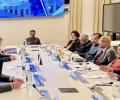
India has secured international support in its fight against terrorism, with Russia, Japan, and the United Arab Emirates expressing solidarity and a commitment to working together to combat the threat. This follows a recent terrorist attack in Pahalgam, India, which claimed 26 lives. Multi-party parliamentary delegations from India briefed the leaderships of these countries on Operation Sindoor, India's response to the attack, and discussed ways to enhance cooperation in counter-terrorism and combating radicalism. These developments highlight the growing global consensus against terrorism and the importance of international collaboration to address this shared challenge.
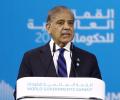
Sharif said that the US president had shown beyond any doubt that "he is a man for peace... and beneficial business deals".
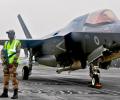
While the peacetime stranding of a foreign fighter jet is rare in India, the F-35 -- a military asset of a foreign country with which India has strategic relations -- was being guarded by the Central Industrial Security Force, the agency responsible for security at Indian airports.
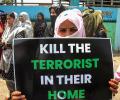
Amid rising tensions between India and Pakistan, the US has called on both countries "not to escalate" the conflict. Secretary of State Marco Rubio is expected to speak with the foreign ministers of Pakistan and India as early as today or tomorrow. The US State Department said Washington is reaching out to both India and Pakistan "regarding the Kashmir situation" and telling them "not to escalate the situation."

The government will send seven all-party delegations to key partner countries, including members of the United Nations Security Council, later this month to convey India's message of zero tolerance against terrorism following the Pahalgam terror attack and Operation Sindoor.
